
The Future of Work is not a prize
There’s nothing behind door #1, #2, or #3.

Hi, it’s Brian.
Every day there is a new prediction about the future of work. Most of them are wrong under scrutiny, but also at the start. Their assumptions about how we move into the future are flawed, and we’ve found ourselves in a moment where the future of work is working against the present of work.
Today’s article is about exactly that. If you want to be someone who has a hand in creating the future of work (and doesn’t make or fall for bad predictions), this is for you.
📅 Upcoming Events
Mar 11 | 🍽️ The Future Solving Club Dinner (NYC) – an application-only evening for VPs of Innovation.
Apr 15 | 🍽️ The Future Solving Club Dinner (Atlanta) – an application-only evening for VPs of Innovation.
May 27 | 🍽️ The Future Solving Club Dinner (Bentonville) – an application-only evening for VPs of Innovation.
Jun 23 | 🍽️ The Future Solving Club Dinner (Chicago) – an application-only evening for VPs of Innovation.
If you’d like to apply to join our community and our events, let us know here.
If you’d like to be a sponsor and cohost, let us know here.
💻Future Solving for Leaders Course
My new course is wrapping up its first cohort, and it’s packed with new frameworks and methodologies I’ve built in practice with Fortune 500 C-suite execs since publishing Autonomous Transformation in 2023. The next 2 cohorts will be fully live.

I’ve been in the business of the future for a number of years now. Across my roles at Microsoft (first as US AI Strategy Lead, then as Global Head of Autonomous AI Co-Innovation for Microsoft Research), in my consulting years, and since leaving Microsoft in 2023 to start The Future Solving Company, I’ve led thousands of dialogues, workshops, briefings, keynotes, and discussions on the future with people across functions, seniorities (emphasis on VP+), and industries.
We are in a moment where the future of work is working against the present of work, and in this article, I hope to clarify some key underlying assumptions and misunderstandings that can unblock individuals and teams when it comes to thinking about, planning for, and ultimately creating the future of work.
1. Stop preparing for the Future of Work
If you were to put yourself on a dot in the middle of a whiteboard, and you had to write down where the future is in relationship to you, where would you put it?
More importantly, who is moving toward whom?
Every futures discipline I’ve come across (except Future Solving) is inherently reactive. “Future proofing,” “future-ready,” the future is coming toward you. And you need to prepare and defend and fortify yourself and your business.
This is why we don’t flinch when someone says something like “we need to prepare our organization for when AI agents are doing all the work.”
There’s nothing more immobilizing than the idea that the future of work is coming at you at lightning speed and there’s nothing you can do but try to prepare and hope it doesn’t sweep you out of work and relevance.
There are people this idea benefits: 1) those who claim to have more insight on the future which they will share with you if you pay for their services and 2) those whose tools are the foundation of the alleged future.
2. Beware of sensationalism
30 years ago, distribution was a signal of credibility. You had to demonstrate your credibility before you could get a book deal, go on national television, or write articles for major publications.
So somewhere deep in our somatic system, when we see a viral post or quotation, there’s a temptation to misread its virality for credibility and seriousness.
This is compounded by the current state of digital platforms, which are oriented toward attention. Reasonable perspectives rarely go viral. Bold claims about the end of xyz job? Telling people they’re going to lose their jobs if they don’t learn the latest framework or technology? These spike adrenaline and stop the scroll. Even if you disagree, if you read it, you’re feeding into the virality of the post from your “dwell time,” even more so if you repost to disagree.
If you disagree and want to “downvote” an idea or someone sharing an outrageous idea, the best thing you can do is scroll past their post or click the … and say “I’m not interested.”
3. Take agency and find others who do too
The Future of Work is not a prize waiting behind a door, and it’s only moving toward you if you’re standing still.
Take Sam Altman, CEO of OpenAI. He’s actively solving for and building toward a future he wants to live in. He’s openly described his dream of AI becoming super intelligent, solving all of humanity’s problems, and eliminating the need for people to work.
Interestingly, Dario Amodei, CEO of Anthropic, has described a very similar future, predicting in May 2025 that AI will eliminate half of all entry-level jobs in the next 1-5 years.
If they’re the only one moving toward, solving for, and working to create the future they want to live in and the rest of us wait, the future we’re going to end up in is going to look like theirs (even if we don’t get to superintelligence, it will be closer to their vision for the future if others do not envision a different future and work with others to solve for it).
Ask yourself: What future do I want to live in? How can I play an active role in creating that future?
4. Beware of science fiction masked as AI research
We’ve been taught to take research seriously.
So how do we handle it when someone who claims they’re an AI researcher publishes a NYT bestseller, a TIME Magazine article, or a research report?
We take it seriously.
But should we? What if that “AI Researcher” has only “researched” how things could go wrong if AI ever became super intelligent? In other words, thinking about how things could go wrong, interviewing people and documenting potential risks, and writing stories about how it could all go wrong and how bad it could be?
That’s not AI research, that’s science fiction.
5. Follow the economic incentives
Anthropic and OpenAI have been releasing reports about how many jobs are exposed to AI. Here’s an example from a report released by Anthropic yesterday:
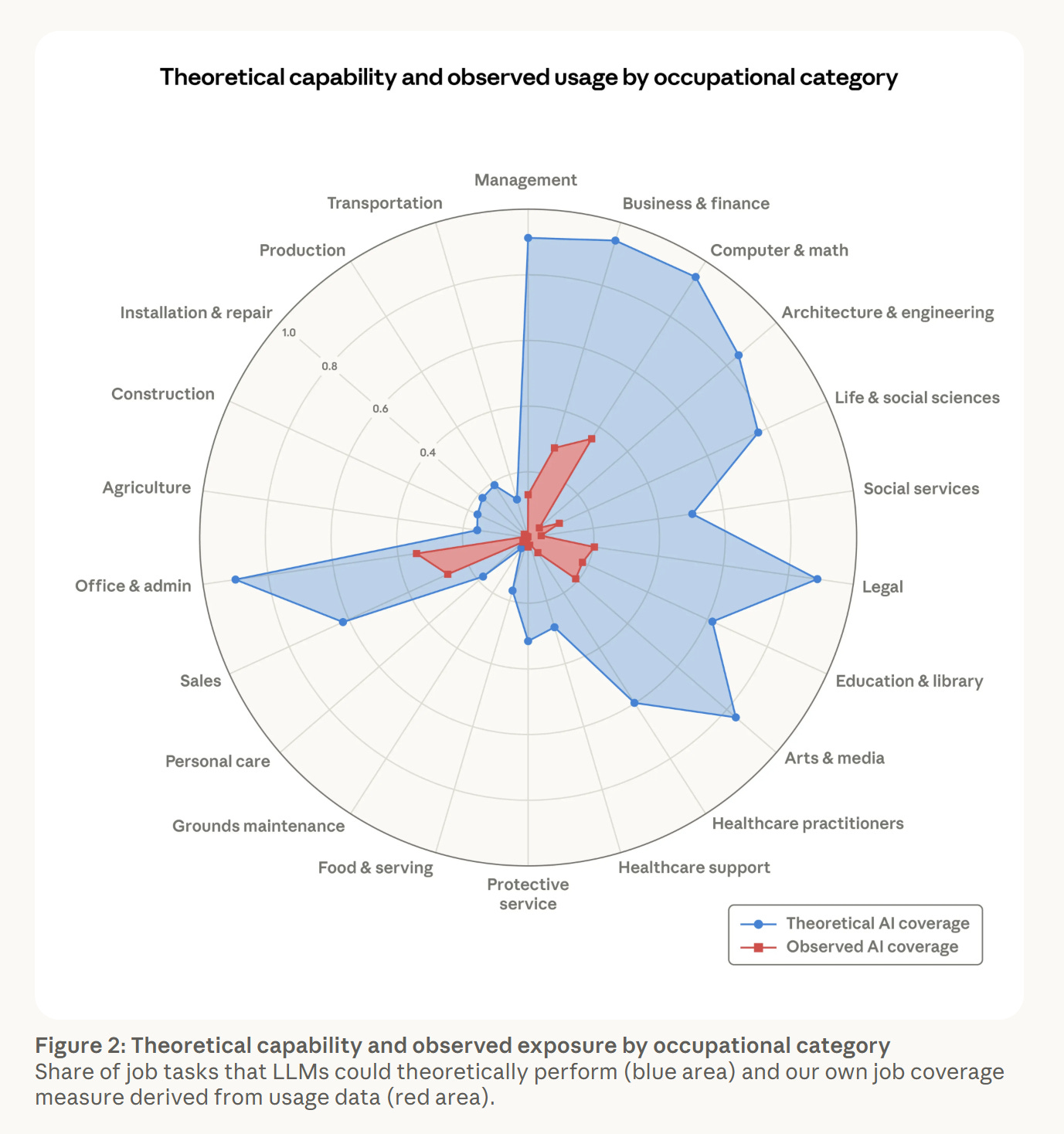
Note the term “theoretical capability.”
It’s like if Expedia released a report on the “theoretical vacationing” people could be doing versus how much they’re vacationing now.
It’s interesting, but not indicative of “where things are heading.”
It’s much more indicative of a company highlighting how much more they think their product could be used.
6. Don’t trust trends
When NFTs were trending, the data was clear: invest in NFTs or you’ll be left behind.
Remember the prompt engineering trend?
Trends indicate interest. Interest is reactive and viral. This creates a self-reinforcing loop independent of proof that there’s anything to the trend worth learning about or investing in.
7. Identify the speed shenanigans
There’s no shortage of people who will say something like “AI is moving so fast, here’s what you missed this week.”
CEOs of Fortune 500 companies (people who have tens of thousands of employees) have shared with me that they spent their weekend reading AI news and experimenting with vibe-coding so they can keep up.
If you zoom out and look at the pace of “AI progress” since ChatGPT was released in November 2022, what step change in capability would dramatically change how you would apply an LLM in your work?
Some of the updates have made LLMs materially better.
But if you’re in a manufacturing facility where you can’t afford hallucinations or you risk physical harm to your employees, you haven’t missed anything.
If you’re a marketer who wants your marketing copy to read like the average of the internet, you can do that better now with the newer models. But should you?
8. Decide what future you want to create
Who is creating the future of work?
Whoever chooses to and has the authority or can influence those who have authority over making investments that will change the trajectory of work.
If you’re reading this and that’s you, then here’s where to start:
Choose the future you want to solve for (anchored on core competency and customer value)
Solve for that future by asking “What would have to be true to make this future inevitable?”
Write down everything you can think of
Call a meeting with others you trust and who have authority and influence to help you create that future
Show them what you’ve come up with and invite them to join you, sharpen your thinking, and align resources
Let me know how it goes.
Thanks for reading,
Brian
Whenever you’re ready, here are 5 ways I can help you:
1. Future Solving for Leaders Course: The most comprehensive course on Future Solving that empowers leaders to take the future into their own hands and create value with it. Join the community of Fortune 500 leaders who are leveraging Future Solving to create the future of their team, department, organization, and market.
2. Keynote Speaking: I’ve lectured everywhere from The Wharton School to Mastercard to Microsoft HQ on AI, AI agents, strategy, the future of work, leadership, and skills of the future. Learn more about booking me as a speaker
3. Sponsor & Cohost a Future Solving Club Breakfast, Dinner, or Virtual Event: The Club hosts breakfasts and dinners in dozens of cities and virtually, in partnership with top enterprise companies, startups, and consulting firms. Here are a few examples: London, Seattle, New York. When we convene these leaders (VP through C-level from over 200 of the Fortune 500) with world-renowned thought leaders to discuss the most pressing topics of today, our cohosts deepen client relationships and expand their network.
4. Future Solving Podcast: My new show (in partnership with Thinkers50) that explores how top thinkers, business leaders, and technologists solve for the future. Previous guests include Rita McGrath, Whitney Johnson, Alexander Osterwalder, and more.
5. The Future Solving Program: Join 50+ of the FORTUNE 500 and NASA, who have positioned themselves for the future in the era of AI by adopting Future Solving to take the future into their own hands and create value with it.