
The Future of Work according to Agentforce

Salesforce invited & sponsored me to attend the launch of Agentforce 3 and learn about the latest updates to their AI agent platform. Here's my take.
Let's talk about AI agents.
I'm the author of Autonomous Transformation, a book about the next era beyond digital transformation that was named one of Thinkers50’s Top 10 Best New Management Books for 2024. Since it was published, over $20B of investment has been architected on the ideas and frameworks in the book, and last year I launched a LinkedIn Learning Course on Autonomous Transformation, AI Agents, and a new way of leading built-for-purpose in the era of AI.
Agents are a core concept in Autonomous Transformation, and I’ve written about them on Substack (here and here), in VentureBeat (here and here), in Fast Company (here), and I recently teamed up with Cassie Kozyrkov and Pascal BORNET to create a course dedicated to the topic: Agentic AI for Leaders.
So let's talk about Agentforce AI agents.
Now that I’ve established who I am and where I’m coming from when it comes to conversations about AI agents, here’s how I got involved with Salesforce:
Salesforce reached out to me a couple of months ago asking if I would be interested in partnering with them during their Week of Agentforce to learn more about Agentforce 3, then writing my take on it. My neutrality and credibility with all of you is important to me, so we agreed that my point of view would be 100% my point of view (e.g. none of what you're about to read is copy/pasted or written by anyone but me).
Here’s what we did:
Salesforce sent me embargoed materials about the investments Salesforce is making and the capabilities they're launching with Agentforce 3
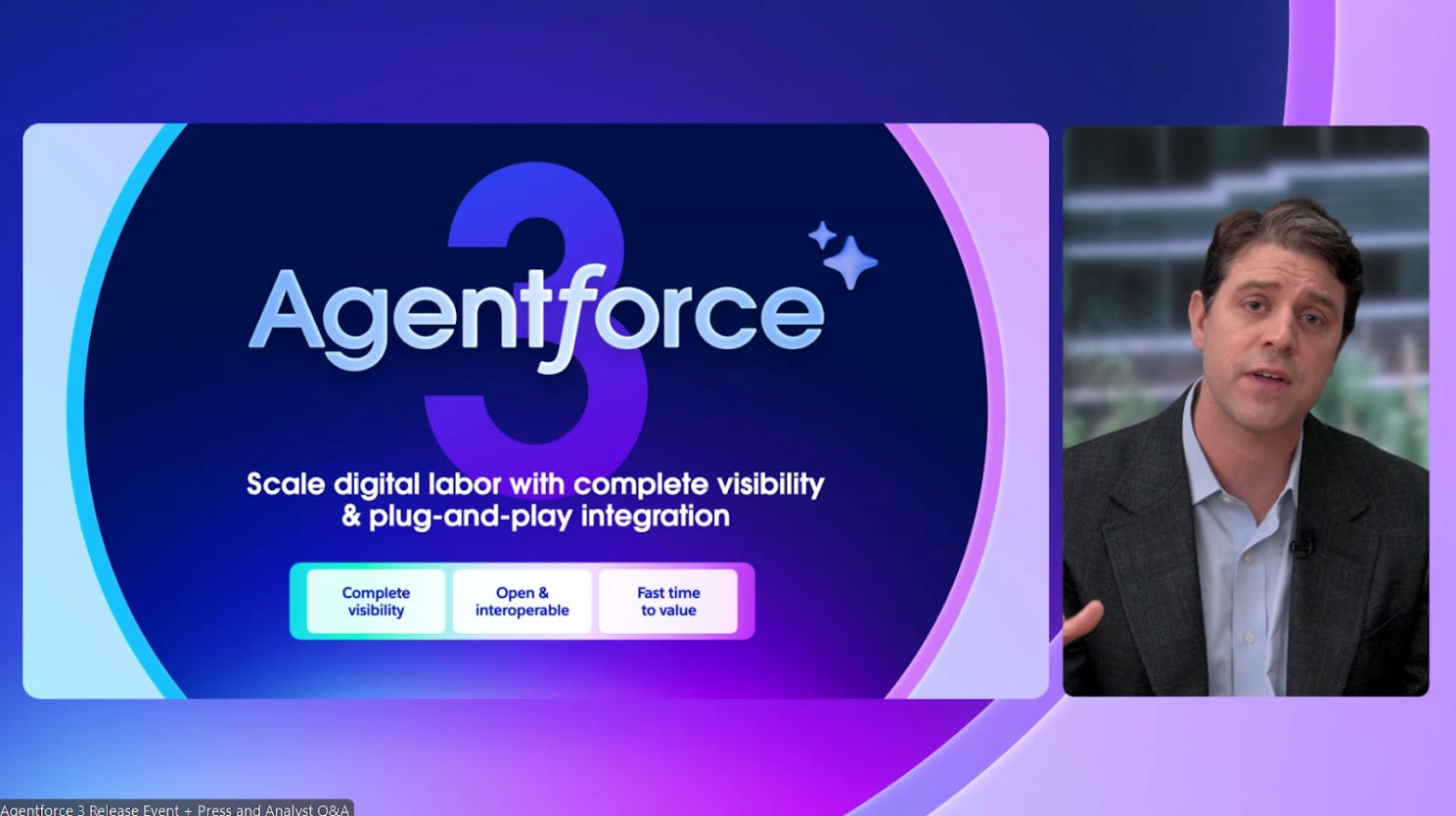
I watched the Agentforce Release Event and participated in a live Q&A for press & analysts
I interviewed Meredith Brown (Salesforce's Senior Vice President of Trailhead & Community). You can watch the full interview below:
I interviewed Ryan Gavin, Slack's Chief Marketing Officer, and learned about Salesforce and Slack's vision for integrating AI agents directly into the flow of work.
Here's my point of view
1. Salesforce has a strong vision for the future of work
According to Ryan Gavin (Slack's CMO), we're moving into the "Productivity Boom of the 2020s." I couldn't agree more.
He put it well: "Work is going to change more in the next 5 years than it has in the last 25 years."
Since 60% of most organizational capital is spent on employees, leaders are asking how they can get a greater return on their investment.
AI agents provide an elegant potential answer, since we spend ~40% of our time looking for and formatting information. Time lost on the work of work.
The future Meredith Brown (SVP at Salesforce) shared with me is one in which our human personnel get that 40% of their time back to be more connected, more creative—dare we say more human?
Our individuality, creativity, and "humanness" is our greatest competitive advantage. Freeing up more of that is going to have a direct impact on organizations’ top and bottom line.
2. Agentforce 3 is a thoughtfully engineered advancement, focused on addressing three key blockers to scaling AI agents: visibility, interoperability, and time to value
Building AI agents is hard, pioneering work. There's no easy button, and there are so many directions companies at the size and scale of Salesforce could focus their investments.
Without diving too deep into the technical aspects (let me know if you want to dive deep and I can connect you with the right team at Salesforce), the capabilities Salesforce is announcing with Agentforce 3 are important building blocks toward the future of Autonomous Transformation.
Unlike the "walled-garden" approach many leading companies took with operating systems and mobile phones, Salesforce sees the truth: organizations are going to build AI agents using many different platforms and visibility and interoperability between those agents regardless of where and how they were built will be critical to long-term success.
Lastly, because we live in a world of shareholder primacy, organizations who take too long to design, develop, implement, and create value with agents run the risk of funding cuts and discontinued pilots and projects. Salesforce has invested in creating the resources organizations will need to shorten time to value so they can earn deeper investment in the longer term, higher-value transformation.
3. Salesforce and Slack have a significant moat: the long-term memory of work
Every agent system can access structured data (e.g. data in tables like a list of customers or orders), but very few can ingest unstructured data (like conversations, pdfs, slides, etc.).
Between Salesforce and Slack, organizations who decide to build AI agents using Agentforce will have immediate access to their organization's structured and unstructured data, which will enable those agents to better understand organizational nuances that can't be explicitly trained.
If I ask an agent to pull up and analyze a 360 customer report from 2024 and create a template for my 2025 360 customer report, here's the difference:
Agent that only has access to my tables: "Unable to find ‘"360 customer report from 2024.’ Can you be more specific?"
Agent that has access to my tables and conversational history: "Here's the file: 'ACME 360_Final_July_2024'. It looks like your colleague Jack was concerned about whether or not you could break into the customer's marketing function in 2025, which was echoed by your leadership in the review. You now have 3 signed SOWs with the marketing function and a healthy pipeline going into H2, so this will be important to highlight to demonstrate your team's ability to break into dark accounts and functions."
Any organization that's already using Slack can tap into what Ryan Gavin (Slack's CMO) called "the long-term memory of work" of their organizations as they develop AI agents using Agentforce. This is important to note when reviewing AI agent offerings from various vendors. 1. Where is the long-term memory of your organization collected? 2. Which organization has the most native understanding and access to leverage that information to give AI agents rich context for every task?
4. My only critique (so you know this is a fair and honest piece): Calling AI agents "coworkers" or "teammates" could confuse people and inhibit adoption
AI and jobs is an extremely sensitive topic right now, as pundits and company leaders make pronouncements about how much longer entry-level jobs will exist, whether AI will take people's jobs, etc.
While these statements are immediately regarded as hype by AI experts, the majority of knowledge workers and front-line workers could experience uncertainty about their roles when they hear this kind of language (research shows we experience uncertainty as physical pain), which could significantly affect productivity and adoption (e.g. if a business is approaching it under the guise as "a new AI coworker" versus if a business is approaching it as "a new supporting tool that can take care of more complex tasks than previous tools").
We as people hold accountability for the work in our organizations, so when we request a coworker or teammate to handle something and they agree, we're transferring accountability and/or responsibility to that other person for the quality, speed, and (perhaps even) cost of that task or range of tasks. We can't and shouldn't try to transfer accountability and/or responsibility to AI agents for our work, so referring to them as coworkers, colleagues, or teammates subtly sets us up for a cognitive fallacy and abdication of responsibility.
I'd love to see Salesforce double down on the language they’re already using that does not anthropomorphize AI tools.
I'm grateful for the opportunity to see these developments unfold firsthand, and am excited for the future of work Salesforce and Slack are building toward.
I asked Salesforce if leaders from my community interested in learning more about Agentforce 3 and AI agents can skip the line and be introduced to the head of Agentforce for their function or industry, to which they’ve graciously agreed. If that’s you, DM me and let me know.
If you'd rather explore on your own, learn more about Agentforce here.
Thanks for reading,
Brian
Whenever you're ready, here are 3 ways I can help you:
1. Keynote Speaking: I've briefed dozens of Fortune 500 C-suite executive teams, spoken to live, in-person audiences of more than 10,000 attendees, am a guest lecturer at Kellogg School of Management, and have led panels of distinguished guests ranging from academia to public sector leaders to Fortune 500 C-suite executives.
2. Future Solving Advising: Join hundreds FORTUNE 500 C-level executives and startup founders who have leveraged my advisement on AI, the future of technology, and how to position yourself for the future in the era of AI.
3. Future Solving Workshops: Join 50+ of the FORTUNE 500 and NASA, who have positioned themselves for the future in the era of AI by leveraging new frameworks from the Future Solving Method I introduced in my book, Autonomous Transformation, to set a vision and strategy and spark action.
1 Evergreen, B. (2023, pg. 14). Autonomous transformation: Creating a More Human Future in the Era of Artificial Intelligence. John Wiley & Sons.