
People will be the UI
The case for going human-first in 2026

Hi, it’s Brian.
Sorry for the hiatus. I took a short break from writing — I’ve been busy launching our new podcast, Future Solving, planning for 2026, developing a more comprehensive portfolio of offerings for organizations (reply and let me know if you’d like to see our portfolio) and writing for other publications, like this one: No strategy without vision.
Today’s piece was inspired by a recent conversation with a Fortune 500 CEO on the future of products and services.
📅 Upcoming Events
Mar 11 | 🍽️ The Future Solving Club Dinner (NYC) – an application-only evening for VPs of Innovation.
Apr 15 | 🍽️ The Future Solving Club Dinner (Atlanta) – an application-only evening for VPs of Innovation.
May 27 | 🍽️ The Future Solving Club Dinner (Bentonville) – an application-only evening for VPs of Innovation.
Jun 23 | 🍽️ The Future Solving Club Dinner (Chicago) – an application-only evening for VPs of Innovation.
If you’d like to apply to join our community and our events, let us know here.
If you’d like to be a sponsor and cohost, let us know here.
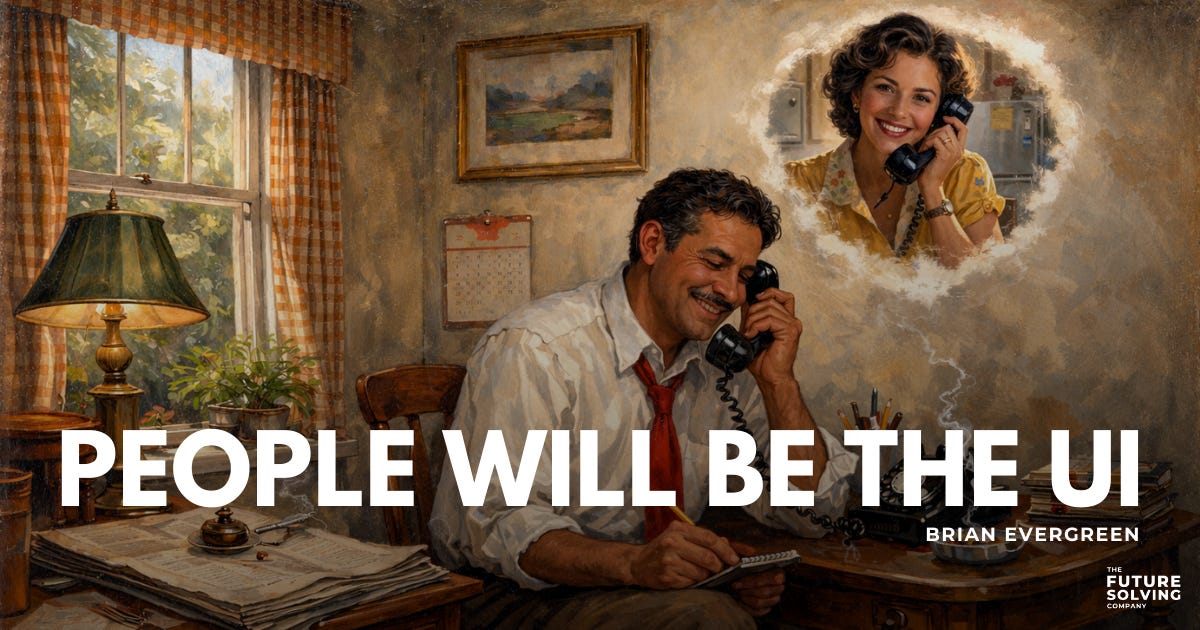
100 years ago, 750,000 women were employed in the United States as “washerwomen.” They provided a service washing clothing for families.

Then the washer-dryer was invented and the service washerwomen provided was replaced with a new product.
30 years ago, the same thing happened to travel agents. As people could book their own travel through the likes of Travelocity, Expedia, and (later) AirBnB, the service provided by travel agents was replaced by a product.
In the past 100 years, innovators have focused on transforming as many services into products as possible, thanks to the new ability to mass produce physical goods, hardware, and software.
Now we have a product management problem
(but not the kind you might think)
Most of us wake up in the morning with a long backlog of to-dos, most of which involve calling call centers and waiting, sending emails to faceless customer service inboxes, logging into apps to order or book something, and so on.
With each product that’s been created to make our lives easier, more work has been incrementally shifted back onto our plates.
With AI, this risks becoming exponential. I don’t know about you, but I don’t want to "quickly chat” with an AI chatbot from every company I interact with. Even if it seems like it could be useful (which is so often is not), now I’m locked into that browser window until the conversation is finished.
AI as the new UI is backward
People are accepting chatbots and AI as the updated UI because it’s the best we have. In the paradigm where the “digital storefront” has been a website or app that requires manually clicking through menus, searching and scrolling through options, and filling out forms, the idea of an AI that can understand intent and handle tasks for us is appealing.
But the trust isn’t there. Neither for understanding what we actually want, nor for taking the right action. It also doesn’t bear any social responsibility the way a person does—even someone we’ve never met.
This is why most of us would have a worn out 0 button from customer service calls if we were still using home phones.
Why people should be the new UI
Speaking to other people for booking appointments, resolving issues, planning, and answering quick questions is much easier.
Despite user preference, companies have moved further and further from the ability to reach a person on the first call because of cost.
With all that AI can now do, the cost can finally go down, but not through removing humans from the loop (see case study from Klarna). They should instead embrace being human-first, placing humans back into the front of the customer interaction as the interface, with AI as the middleware (e.g. the AI empowers the person taking the customer calls to handle whatever’s needed as quickly as possible).
The 2 forms this could take
1. Companies differentiate from each other by going human-first (e.g. humans as the new UI)
Example: Expedia creates a new user experience for an added subscription or for users planning a trip with a budget above a certain threshold (in exchange for a small percentage of the overall booking), where they will have the option to do a phone call or video call with a travel agent who will use a network of relationships, AI, and AI agents to design the trip, present it to the customer for feedback and approval, proceed with booking, and be available throughout the trip as a virtual concierge.
Example: Uber decides to differentiate from its competitors by letting you text or call someone when you need to be picked up as a new subscription or a loss-leading differentiator.
2. Companies wait, and startups pop up with humans as the new UI
- Human-first domain-specific startups will start to pop up and disrupt industries that are not insulated
Example: A new travel agency where you can speak to a person who will use a network of relationships, AI, and AI agents to design the trip, present it to customers for feedback and approval, proceed with booking, and be available throughout the trip as a virtual concierge. Thanks to the technology available today, this would be achievable for a very small percentage fee added to the overall booking.
Example: A new shopping boutique that uses a human as the interface for anything a customer would have bought across grocery stores, Amazon, Uber Eats, DoorDash, Home Depot, etc. so the customer has a single, trusted point of entry that will be up-to-date on the best pricing across stores, logistics, and understands the style, allergies, and quality preferences of the customer. Anything someone needs, they can just text or call them and they handle it.
- Human-first domain-agnostic concierge startups will start to pop up and create a new category (this may happen either way)
Example: A new concierge service where customers are assigned a concierge team who can text with them throughout their waking hours to answer questions, take on tasks such as scheduling, research, booking, shopping, budget management. Like the example above, they would be able to use a network of relationships, AI, and AI agents as the middleware, so the human time could primarily be spent customer-facing and the commercial model viable.
Where to start
It starts with vision. In this case I’ve done some lifting for you, and you can start with the question: “How might a human-first interface for my organization or industry be a competitive advantage or
create a new growth category?”
Let me know what you come up with. I’ll be watching this space closely.
Thanks for reading,
Brian
Whenever you’re ready, here are 5 ways I can help you:
1. Future Solving Podcast: My new show (in partnership with Thinkers50) that explores how top thinkers, business leaders, and technologists solve for the future. Previous guests include Rita McGrath, Whitney Johnson, Alexander Osterwalder, and more.
2. Sponsor & Cohost a Future Solving Club Breakfast, Dinner, or Virtual Event: The Club hosts breakfasts and dinners in dozens of cities and virtually, in partnership with top enterprise companies, startups, and consulting firms. Here are a few examples: London, Seattle, New York. When we convene these leaders (VP through C-level from over 200 of the Fortune 500) with world-renowned thought leaders to discuss the most pressing topics of today, our cohosts deepen client relationships and expand their network.
3. Future Solving for Leaders Course: The most comprehensive course on Future Solving that empowers leaders to take the future into their own hands and create value with it. Join the community of Fortune 500 leaders who are leveraging Future Solving to create the future of their team, department, organization, and market.
4. Keynote Speaking: I’ve lectured everywhere from The Wharton School to Mastercard to Microsoft HQ on AI, AI agents, strategy, the future of work, leadership, and skills of the future. Learn more about booking me as a speaker
5. The Future Solving Program: Join 50+ of the FORTUNE 500 and NASA, who have positioned themselves for the future in the era of AI by adopting Future Solving to take the future into their own hands and create value with it.