
My honest take on Agentforce
Salesforce hired me to learn about their AI agent platform, and this is my point of view

Let’s talk about AI agents.
I started having something to say about AI agents back in 2019, when I joined Microsoft US to lead AI Strategy co-creation with iconic customers (after 5 years working in AI as a practitioner and leader at multiple consulting firms).
Starting my second week on the job, I began traveling around the United States to meet with Fortune 500 C-suite teams to talk about AI and how we could co-create strategies for harnessing its potential.
Customers were coming to the table like AI was the next iteration of the cloud—an opportunity to retool the same processes to be more efficient and generate savings.
They were applying the Digital Transformation playbook to AI.
But it wasn’t working because AI doesn’t exactly fit into Digital Transformation, because, by definition, the goal of digital transformation is to transform an organization’s products, services, processes, and structures through the reimagining and converting of analog processes and assets to digital processes and assets.1
AI can be leveraged to reimagine and convert analog processes and assets to digital processes and assets, but only using AI to convert from analog to digital is like only using a plane to drive on the freeway—you end up missing the bigger opportunity.
So, I set about defining the next mile marker, moving from analog or digital to:
au·ton·o·mous
1: having the right or power of self-government
2: existing or capable of existing independently2
I worked on defining this by writing a book called Autonomous Transformation, which was named one of Thinkers50’s Top 10 Best New Management Books for 2024, over $20B of investment has been architected on the ideas and frameworks in the book, and I recently launched a LinkedIn Learning Course on Autonomous Transformation, AI Agents, and a new way of leading built-for-purpose in the era of AI.
And agents? They’re a core concept in Autonomous Transformation, and I’ve written about them on my Substack (here and here), in VentureBeat (here), in CIO (here), and in Fast Company (here).
So let’s talk about Agentforce.
Now that I’ve established who I am and where I’m coming from when it comes to conversations about AI agents, here’s how I got involved with Salesforce:
Salesforce reached out to me a couple of months ago asking if I would be interested in partnering with them on their Agentforce World Tour Seattle to learn more about Agentforce and its recent developments, then writing my take on it. My neutrality and credibility with all of you is critically important to me, so we agreed that my point of view would be 100% my point of view.
Here’s what we did:
I dove under the hood with Muralidhar Krishnaprasad (MK) President and CTO of Agents and Data, Rahul Auradkar EVP and GM of Data Cloud, Alice Steinglass EVP and GM of Salesforce Platform, and Rob Katz VP of Product for Responsible AI in a private meeting with 3 other experts
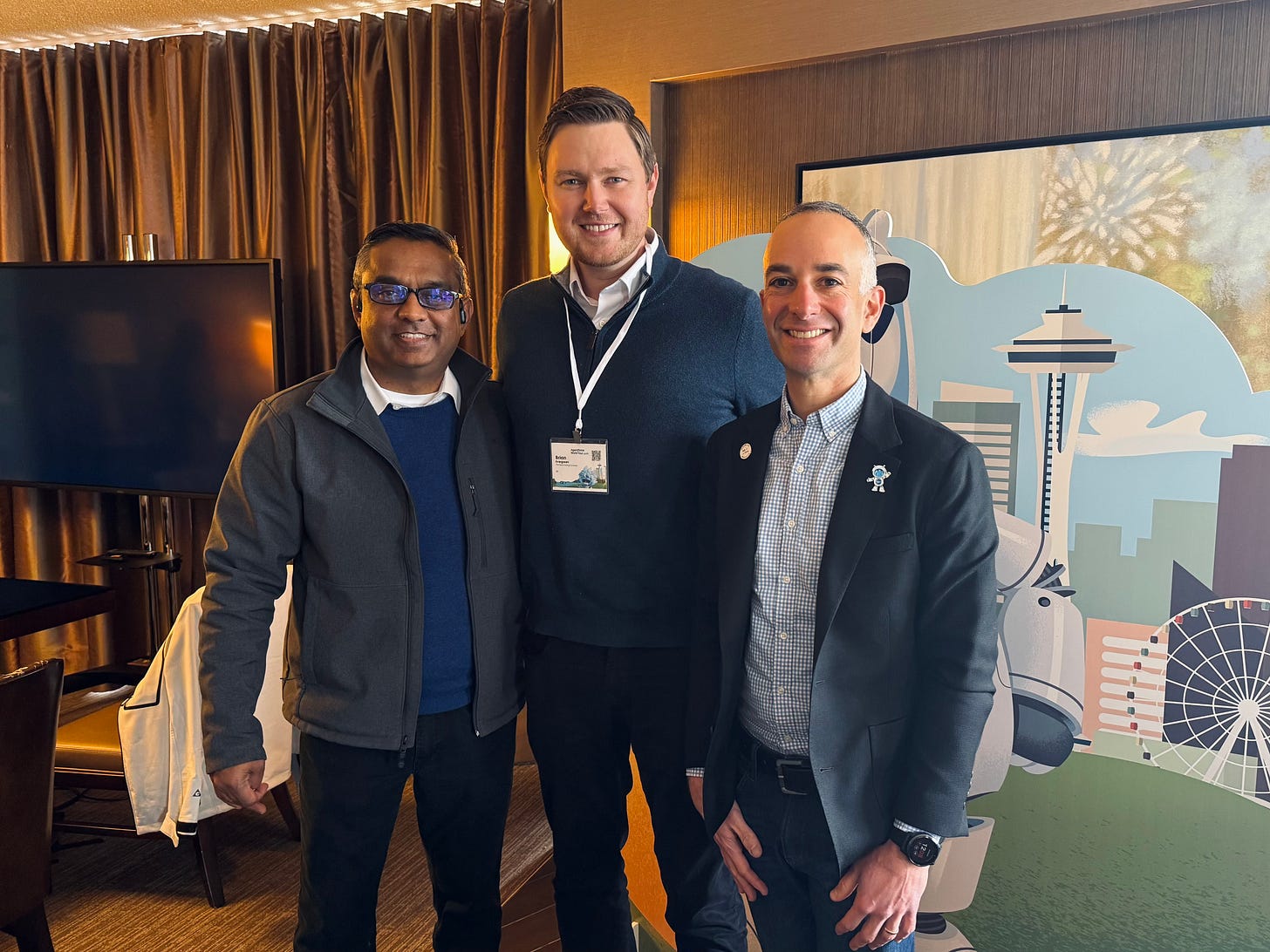
I attended their 1-hour keynote session with 1K other attendees
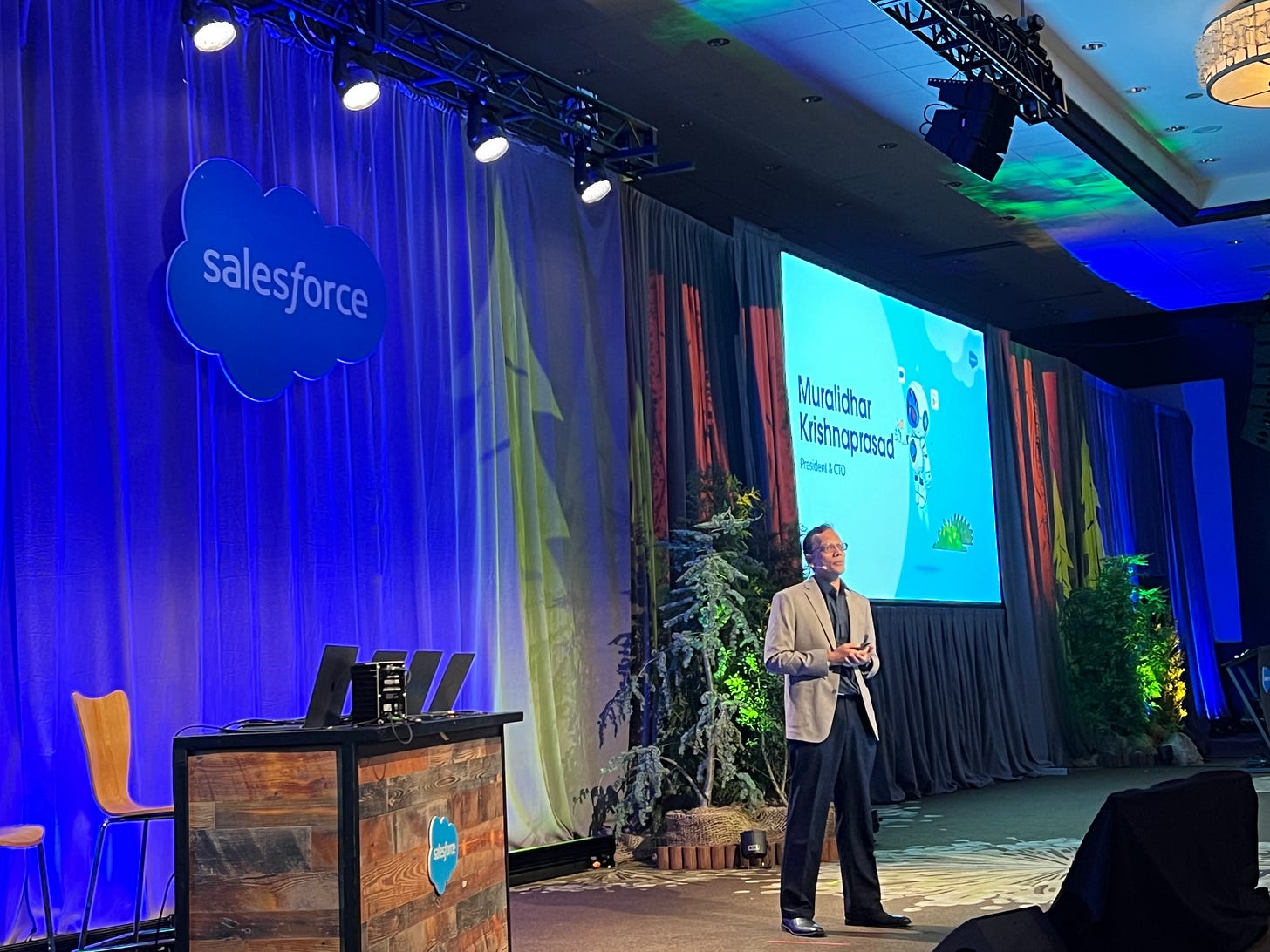
Muralidhar Krishnaprasad, President and CTO of Agents and Data I learned about brands who are already using Agentforce like Wiley, FedEx, and Saks
We came back together for personal hands-on demos and I had another 30 minutes with the executives to ask more questions
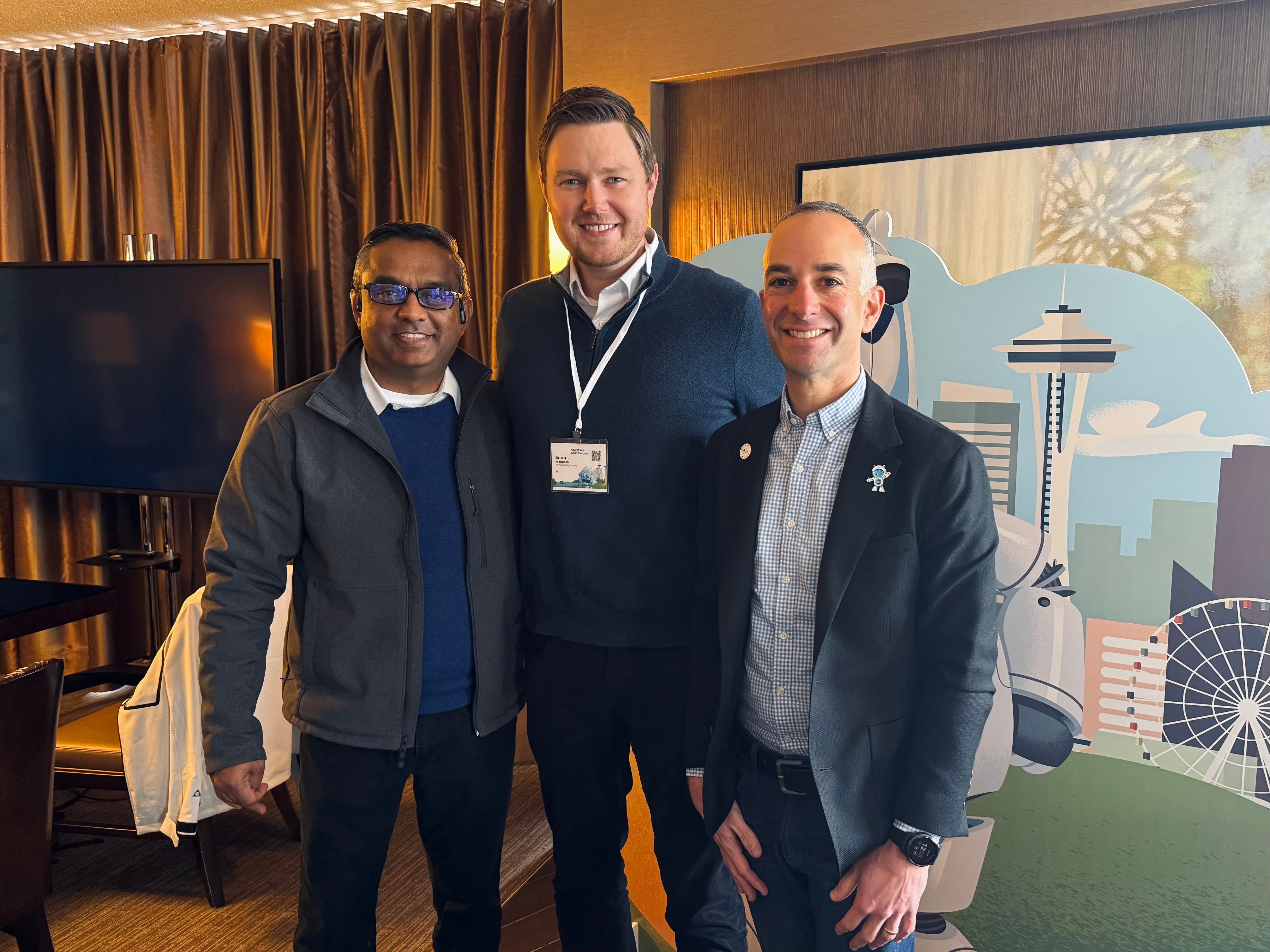
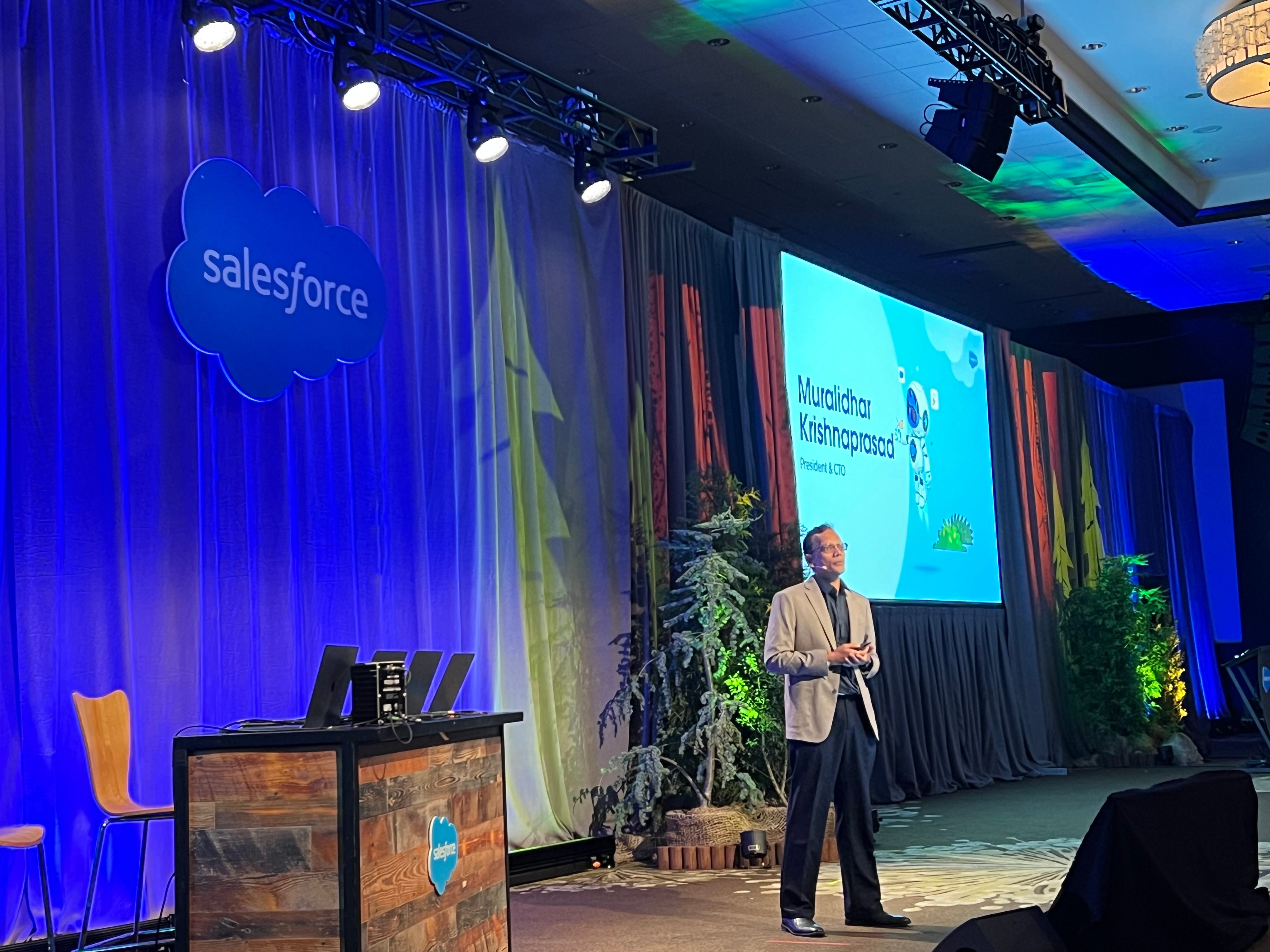
Here’s my point of view
Agentforce gets it right when it comes to Autonomous Transformation
Instead of focusing on automation or increasing efficiencies, Agentforce’s focus is on enabling entirely new value and better customer experiences that weren’t possible before the development of AI agents.
A second key distinction is that one of the critical enablers for organizations to begin their Autonomous Transformation journeys is scalable workbenches that democratize access to powerful models without needing an entire data science team for every initiative. This is because, according to Gartner, there are 10M software developers and only 10K data scientists. I experienced Agentforce’s workbench firsthand, and it has created the means for non-data-scientists to build an AI agent* end-to-end, with the extensibility to plug in more advanced models if you have them.
*the distinction here being that the AI agent would primarily exist (for now) in the realm of sales, marketing, and customer service given Salesforce’s existing data footprint
This video with Saks is a great example and is worth watching:
Agentforce is not a shallow rebrand, it’s anchored on a powerful vision (Humans with Agents drive customer success together), a strong strategy, and it's articulated clearly and simply
With so many companies jumping on the Generative AI and now AI agent bandwagon in the past 2 years, it would be easy to assume that’s what Salesforce is doing. It’s not. This is a carefully thought through vision, a well-developed strategy, and the articulation is understandable to the least technical person in the room.
I recall reading articles earlier this year about Marc Benioff being all-in on Agentforce, and now that I see what they’ve developed and what they’ve already put into production with customers, I can see why.
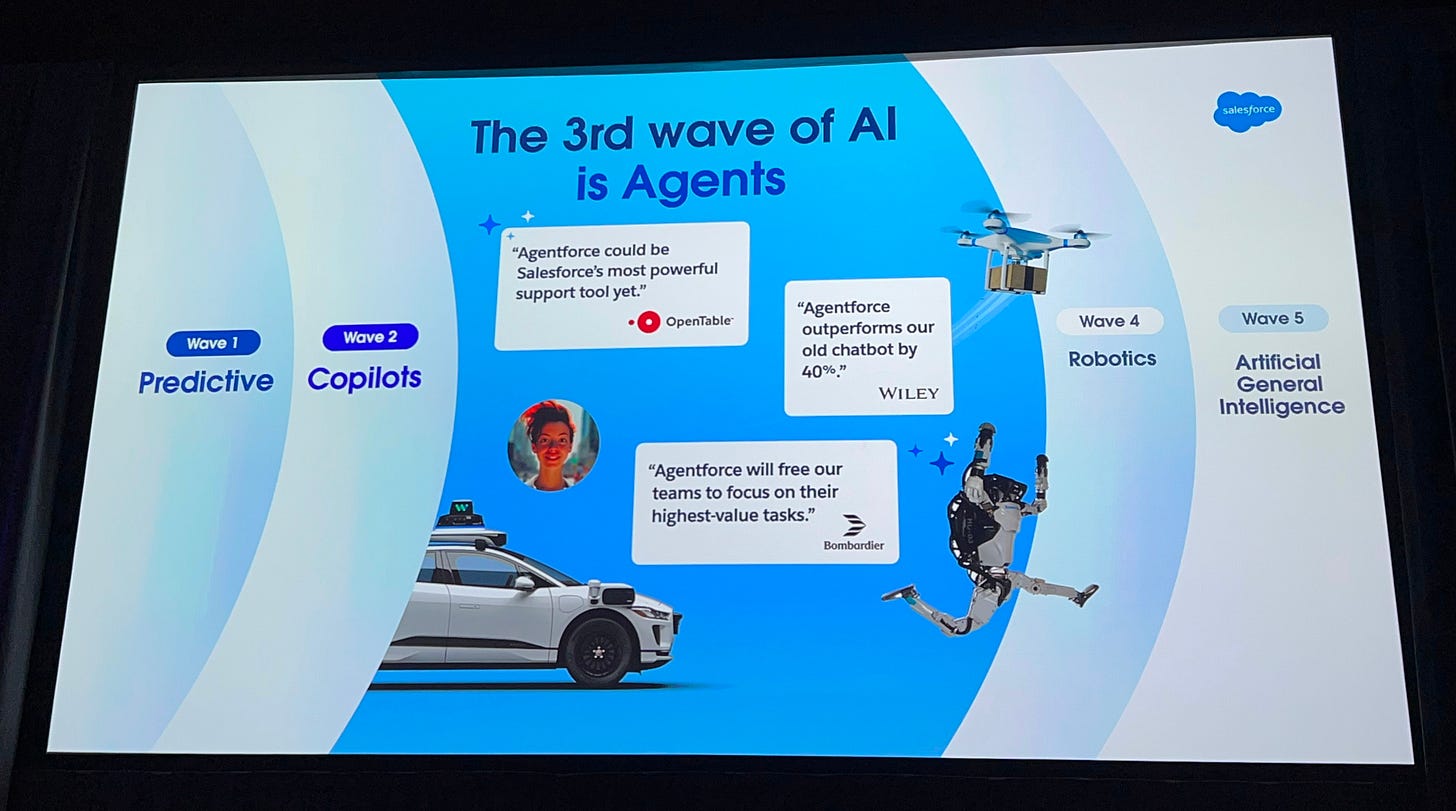
These are agents that actually make decisions and take action
In a previous article, I wrote about how AI Agents are not automation, and that one of the key distinctions between whether something is automation or an AI agent is in how it’s trained, how it makes decisions, and how it interacts with humans. Agentforce falls on the agent side one 3 out of 3 while still being capable of tapping into existing automation so organizations don’t have to reinvent the wheel or write off millions of dollars of investment they’ve already made. An agent is only one piece of the puzzle, and while it’s a useful piece, being able to tap into existing automation and existing APIs is a critical capability to ensure it can be leveraged in tandem with the rest of the pieces.
My only critique (so you know this is a fair and honest piece) is something that I think is a reasonable stepping stone given the trajectory they’re on—the UX for building agents needs to continue to evolve to be even more intuitive
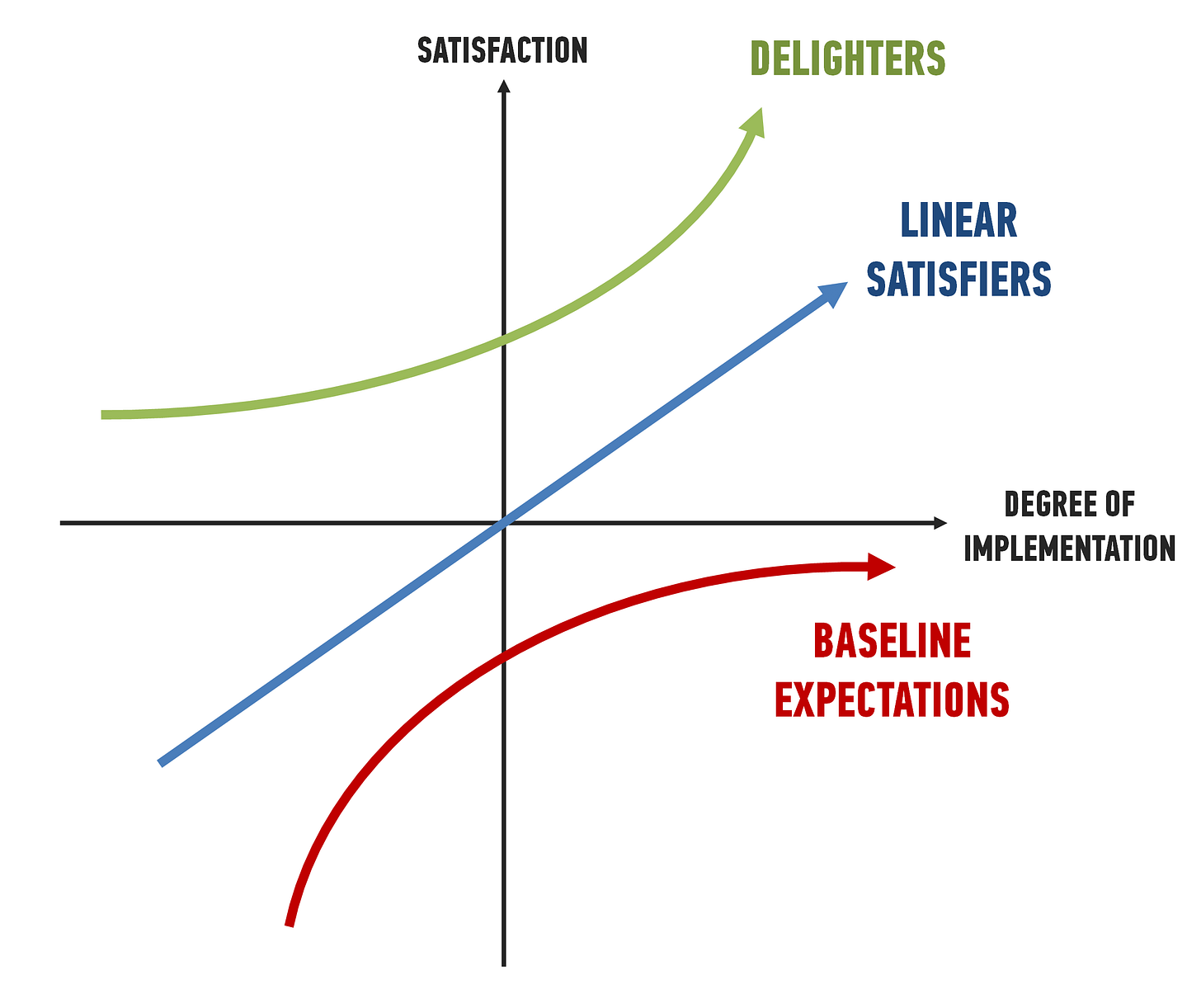
It’s already intuitive enough that agents are getting put into production, which is a high bar. But I hope the next revolution of the platform takes on a new form factor that’s unexpected and truly delightful, with less text, because as we move into the era of Autonomous Transformation, the Kano Model is going to shift, and the ability to create value with agents, which is currently a delighter, will shift to a linear satisfier and eventually a baseline expectation (visual below), so Agentforce will need to continue building new delighters into their platform to enable users to even more intuitively build out the Internet of Agents.
Kano Model
I was genuinely excited after seeing what they’ve accomplished and learning more about their roadmap.
I asked Salesforce if leaders from my community interested in learning more about Agentforce can skip the line and be introduced to the head of Agentforce for their function or industry, to which they’ve graciously agreed. If that’s you, reply to this email and let me know.
Thanks for reading,
Brian
Whenever you're ready, here are 3 ways I can help you:
My LinkedIn Learning Course launched on October 3rd: Organizational Leadership in the Era of AI. This 48-minute course is packed with frameworks and insights to help you lead in the era of AI using the new system of leadership I introduced in Autonomous Transformation and is free to anyone with a LinkedIn Learning subscription.
If you want to go deeper as an individual, you can sign up for my live course Future Solving Fundamentals. My flagship live course on how to position yourself in the future in the era of AI. I share over a decade of AI strategy expertise, proven methods, and actionable strategies. This course sets the stage for a new era of value creation with artificial intelligence. Join leaders from Microsoft, Accenture, Amazon, Disney, Mastercard, IKEA, Oracle, Intel, and more.
If you want to go deeper as a team or organization, I’ve partnered with LinkedIn Learning, Emeritus, and Duarte to create tailored Future Solving™️ programs that leaders at Fortune 500 companies are implementing to help reembrace science in their decision-making and meet the complexities of the 21st century with a system of leadership, strategy, and decision-making that is built-for-purpose for era of artificial intelligence. You can reach out to connect and learn more here.
Evergreen, B. (2023, pg. 14). Autonomous transformation: Creating a More Human Future in the Era of Artificial Intelligence. John Wiley & Sons.
“Autonomous,” Merriam-Webster Dictionary, https://www.merriam-webster.com/dictionary/autonomous.