
I'm not interested in a slightly better future

Especially not when it comes to the biggest challenges we face.
So, I was thrilled when Thinkers50 asked me to contribute a chapter for their new book with Project Management Institute on new ways of thinking about sustainable innovation.
Even more so when they chose my guest chapter as the opening chapter for the book.
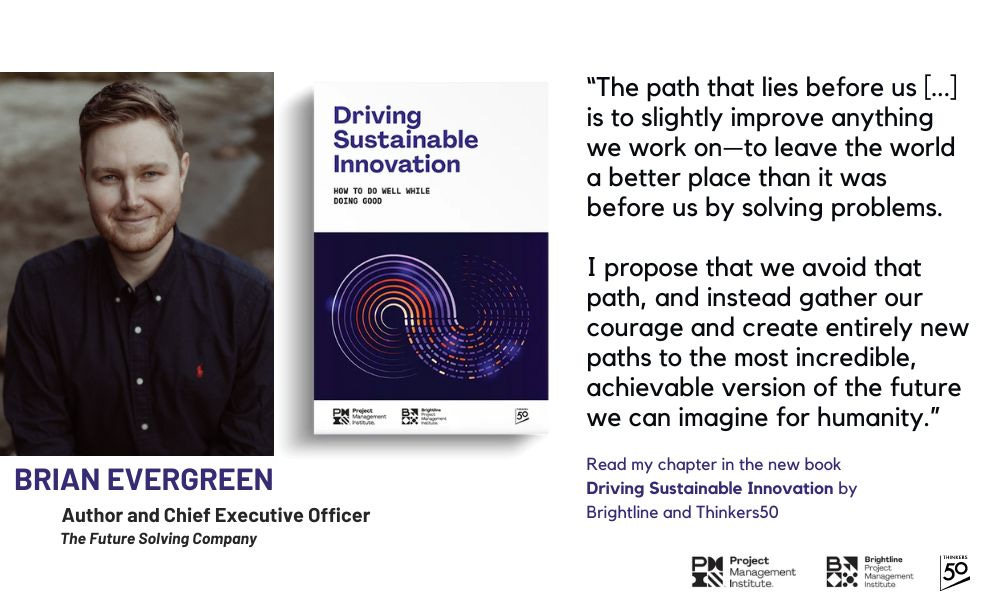
Here’s an excerpt:
"Our reality has been carved out of the earth and given to us by our forebears, who designed and created systems to achieve the dream of giving a better life to future generations. Readily accessible food, clothing, shelter, and goods; curing the world’s most devastating diseases and then making those cures widely available; creating access to education; being able to travel and learn from people and cultures around the world—these were only dreams in the year 1900, when those less fortunate were unlikely to have access to a meal that included meat even once a week, airline travel did not exist, cars had been invented but had not been produced in large quantities, and the average life expectancy was just 48 years old.
If we take one of these examples, such as access to meat, it was a national talking point in the United States in the 1920s, with broad spread of the phrase: “A Chicken in Every Pot.” It was considered a genuine problem at the time—one that would significantly benefit society if solved. If we draw a line from that problem to today, they did it. It’s been solved. But in its place concerns have arisen about climate impacts, the treatment of animals, and the health impacts of the current diet of citizens of most developed countries.
This can be generalized across all our existing systems, which were built on an oil-and-gas-powered foundation, together with a lack of understanding of social and environmental impacts because they were creating something new to solve a problem in front of them. What they created through a century of progress is a network of systems on which our existence has been scaffolded, but which we now know are not sustainable for the long-term existence of humans on Earth.”
The chapter continues for eleven more pages and covers the “recipe for inaction,” proposing a “recipe for action” instead, and makes the case for how neither problem solving, nor data-driven decision-making will create a more sustainable planet. And of course for anyone who knows me, it will be no surprise that it includes no fewer than four frameworks.
You can read my chapter in the new book here: https://bit.ly/4etFORC
You can also join us next Thursday for a webinar discussing some of the new ideas presented in the book: https://bit.ly/4b8L9ek
I, for one, think we can do better when it comes to solving for our future, and that a shift in our ideas will be the foundation of creating a better future together.
Thanks for reading,
Brian
PS — Become a member to get access to my leader membership including weekly Tuesday deep dives, fireside chats, and more.
Whenever you're ready, here are 3 ways I can help you:
My LinkedIn Learning Course launched on October 3rd: Organizational Leadership in the Era of AI. This 48-minute course is packed with frameworks and insights to help you lead in the era of AI using the new system of leadership I introduced in Autonomous Transformation and is free to anyone with a LinkedIn Learning subscription.
If you want to go deeper as an individual, you can sign up for my live course Future Solving Fundamentals. My flagship live course on how to position yourself in the future in the era of AI. I share over a decade of AI strategy expertise, proven methods, and actionable strategies. This course sets the stage for a new era of value creation with artificial intelligence. Join leaders from Microsoft, Accenture, Amazon, Disney, Mastercard, IKEA, Oracle, Intel, and more.
If you want to go deeper as a team or organization, I’ve partnered with LinkedIn Learning, Emeritus, and Duarte to create tailored Future Solving™️ programs that leaders at Fortune 500 companies are implementing to help reembrace science in their decision-making and meet the complexities of the 21st century with a system of leadership, strategy, and decision-making that is built-for-purpose for era of artificial intelligence. You can reach out to connect and learn more here.