
How to use LLMs to lose to your competitors
A mixology for enterprise leaders

Hi, it’s Brian.
I teamed up with VentureBeat to bring you an AI mixology because sometimes an analogy is the best way to make things clear.
If you’ve ever felt like LLMs alone shouldn’t be the strategy, this is for you.
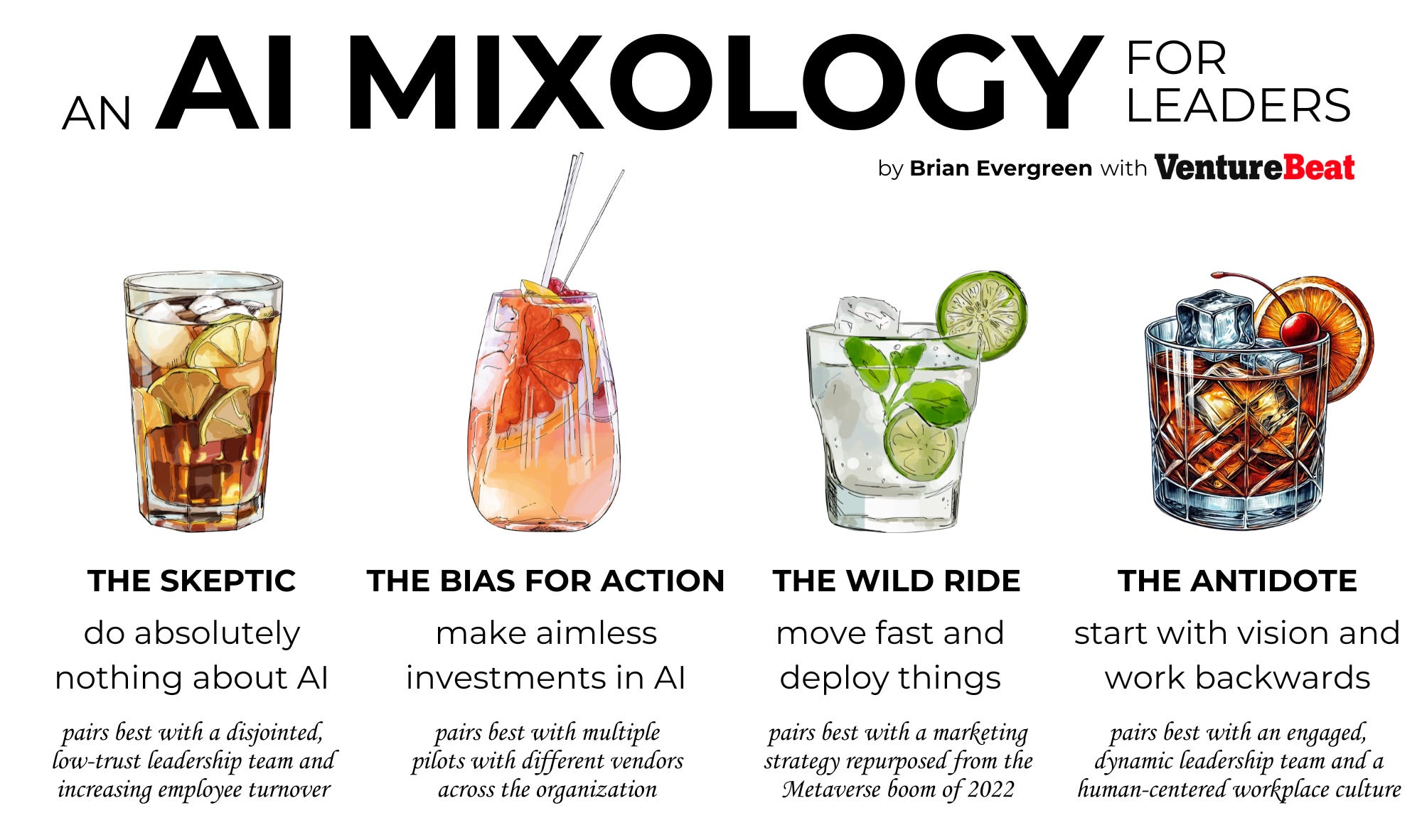
Things are moving so quickly in the era of AI. New open-sourced models, research breakthroughs, and product launches are announced daily. Who has time for setting a vision or creating a strategy? It’s impractical, and we have to make investments now.
For fast-moving executives, this is a set of quick and to-the-point recipes for different approaches you can take when it comes to language models. Each of these recipes is best prepared on the rocks.
The skeptic: Do absolutely nothing about AI
This is the most efficient approach, as it requires no mobilization of resources. Stay the course. Focus on incremental improvements to your value proposition and driving cost out of the bottom line. If your leadership or board asks about your plans for AI, take the position of the skeptic and chalk all of this AI stuff up as hype. Keep a log of failure stories of other organizations trying to use AI and use them as leverage against anyone making the case for why AI is an important investment focus for your organization. Take bets on when it will become clear that competitors have overtaken you, and make sure you time your exit before that becomes clear to the rest of the market.
Pairs best with a disjointed, low-trust leadership team and increasing employee turnover.
Announcement: My new course will continue to run live for the next 2 cohorts, with 12 hours of live sessions & a capstone project. My gift to subscribers of this newsletter is $1000 off the list price of my course with the promo code: SPRING

The Bias for action: Make aimless investments in AI
If you want to draw out and savor the experience of losing, make investments in large language models (LLMs) without doing the strategy work to determine if language models are the next right investment for building on your organization’s core competencies or for your customers. Search for use cases targeting return on investment that can be reported to your leadership and double down on those metrics. Don’t worry yourself with transformation when you can meet your numbers with “Digital Reformation.”* There isn’t time for that.
Pairs best with multiple pilots with different vendors across the organization.
*Digital Reformation is the process of reforming, or improving the performance of, an organization’s products, services, processes or structures through the conversion of analog processes and assets to digital processes and assets without changing the nature of those products, services, processes or structures.
The wild ride: Move fast and deploy things
If you enjoy the adrenaline rush of roller coasters, schedule time later this week to announce a plan for how you’re going to infuse AI into everything you do and release an initial, topical layer of AI as quickly as possible so that your stock price can surge, enabling a slow decline followed by an exciting dive as your competitors who did the harder strategy, recruiting, and culture-building work build momentum and overtake you.
Pairs best with a marketing strategy repurposed from the Metaverse boom of 2022.
The antidote: Start with vision and work backwards
This option is much less exciting at first, but it will be worth it in the long run. It starts with setting a vision for the future you want to create. This means setting aside time outside of operational meetings to sit, brainstorm and set a vision as a leader (no, not a mission statement) such as “Our organization should have zero workplace safety incidents,” “We need to lower the effort involved in getting access to healthcare expertise,” or “Our company should be the kind of company where the younger generations of the workforce want to build their whole career.”
Once the vision is set, it should be socialized with peers and team members — a vulnerable but necessary step for getting feedback, building consensus, and generating momentum. After everyone is aligned on a shared vision for the future, work together to chart what would have to be true to bring that vision to fruition. Language models may very well play a role in that, but they also may not, and that’s okay.
Pairs best with an engaged, dynamic leadership team and a human-centered workplace culture.
Thanks for reading,
Brian
(I first wrote this on April 28th, 2024 in VentureBeat. You can read the original on VentureBeat here)
💻Live Course (e.g. The Antidote): Future Solving for Leaders
My new course just wrapped up its first cohort, and it’s packed with new frameworks and methodologies I’m willing to guarantee you haven’t seen before. If you join the first session and don’t agree, we will issue you a full refund.
Here’s what one of the recent students (a VP at Visa) shared about their experience:
“At a moment when organizations are under enormous pressure to respond to AI without a clear sense of direction, Brian’s Future Solving methodology offers exactly what’s missing: a rigorous, human-centered way to start with vision and work backwards — solving for the future rather than just reacting to it as it arrives. This course changes how you think — about strategy, about how to communicate ideas, and about the systems you’re trying to change. For any leader trying to create the future rather than just react to the moment, this course is essential.”
(be sure to use the $1000 discount code for subscribers: SPRING)
If you know a leader who might benefit from joining, I’d be grateful if you forward this email along to them.
Whenever you’re ready, here are 5 ways I can help you:
1. Future Solving for Leaders Course: The most comprehensive course on Future Solving that empowers leaders to take the future into their own hands and create value with it. Join the community of Fortune 500 leaders who are leveraging Future Solving to create the future of their team, department, organization, and market.
2. Keynote Speaking: I’ve lectured everywhere from The Wharton School to Mastercard to Microsoft HQ on AI, AI agents, strategy, the future of work, leadership, and skills of the future. Learn more about booking me as a speaker
3. Sponsor & Cohost a Future Solving Club Breakfast, Dinner, or Virtual Event: The Club hosts breakfasts and dinners in dozens of cities and virtually, in partnership with top enterprise companies, startups, and consulting firms. Here are a few examples: London, Seattle, New York. When we convene these leaders (VP through C-level from over 200 of the Fortune 500) with world-renowned thought leaders to discuss the most pressing topics of today, our cohosts deepen client relationships and expand their network.
4. Future Solving Podcast: My new show (in partnership with Thinkers50) that explores how top thinkers, business leaders, and technologists solve for the future. Previous guests include Rita McGrath, Whitney Johnson, Alexander Osterwalder, Tomas Chamorro-Premuzic, and more.
5. The Future Solving Program: Join 50+ of the FORTUNE 500 and NASA, who have positioned themselves for the future in the era of AI by adopting Future Solving to take the future into their own hands and create value with it.