
How to see the bigger picture re: AI agents

Below is an excerpt from a recent VentureBeat article I co-authored with Pascal Bornet. You can read the full article here.
As we step fully into the era of Autonomous Transformation, AI agents are transforming how businesses operate and create value. But with hundreds of vendors claiming to offer “AI agents,” how do we cut through the hype and understand what these systems can truly accomplish and, more importantly, how we should use them?
The answer is more complicated than creating a list of tasks that could be automated and testing whether an AI agent can achieve those tasks against benchmarks. A jet can move faster than a car, but it’s the wrong choice for a trip to the grocery store.
Why we shouldn’t be trying to replace our work with AI agents
Every organization creates a certain amount of value for their customers, partners, and employees.
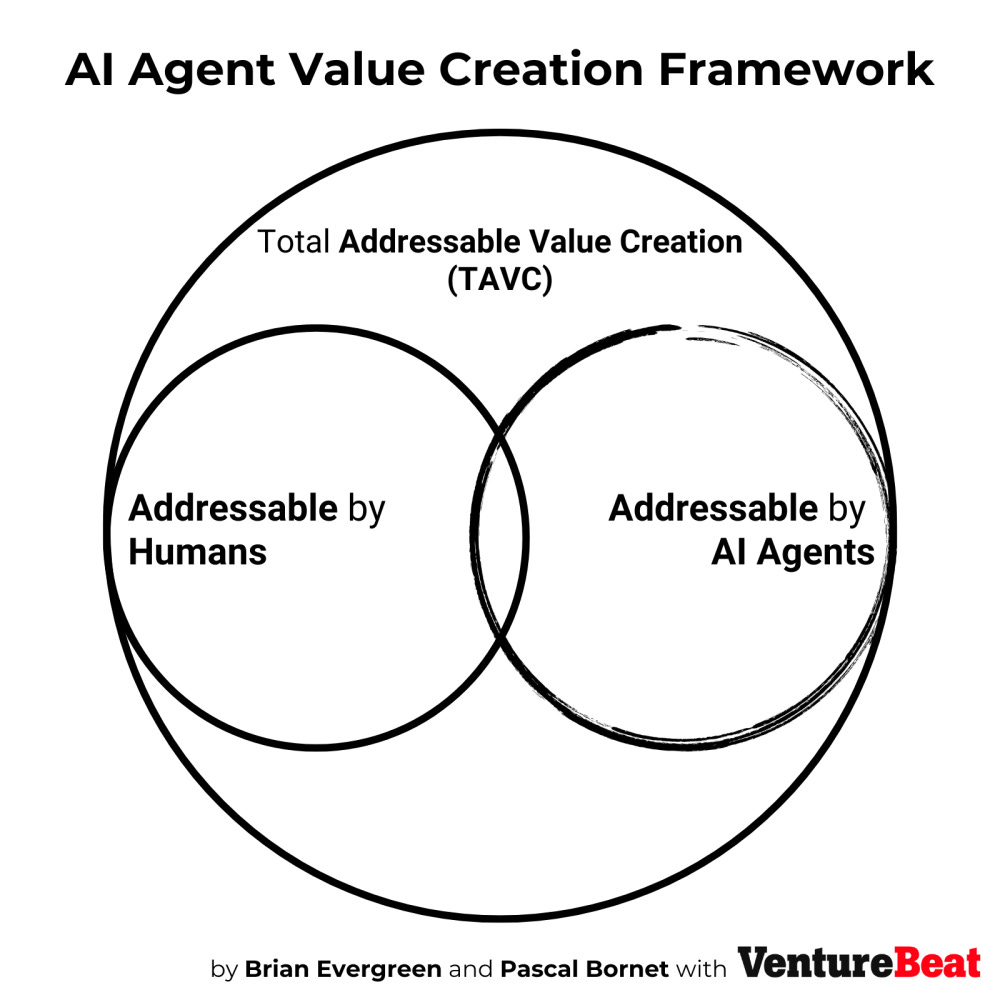
This amount is a fraction of the total addressable value creation (that is, the total amount of value the organization is capable of creating that would be welcomed by its customers, partners, and employees).
If every employee leaves the workday with a long list of to-dos for the next day and another list of to-dos to deprioritize altogether — items that would have created value if they could have been prioritized — there is an imbalance of value, time, and effort, leaving value on the table.
The easiest place to start with AI agents is looking at the work already being done and the value being created. This makes the initial mental math easy, as you can map the value that already exists and analyze opportunities to create the same value faster or more reliably.
There’s nothing wrong with this exercise as a phase in a transformation process, but where most organizations and AI initiatives fail is in only considering how AI can apply to value already being created. This narrows their focus and investments to the narrow overlapping sliver in the Venn diagram below, leaving the majority of the addressable value on the table.
Humans and machines inherently have different strengths and weaknesses. Organizations that collaboratively reinvent work with their business, technology, and industry partners will outplay those who merely focus on one body of value and endlessly pursue greater degrees of automation without increasing total value output.
Understanding AI agent capabilities through the SPAR framework
To help explain how AI agents work, we’ve created what we call the SPAR framework: sense, plan, act, and reflect. This framework mirrors how humans achieve their own goals and provides a natural way to understand how AI agents operate.
Sensing: Just as we use our senses to gather information about the world around us, AI agents collect signals from their environment. They track triggers, gather relevant information, and monitor their operating context.
Planning: Once an agent has collected signals about its environment, it doesn’t just jump into execution. Like humans considering their options before acting, AI agents are developed to process available information in the context of their objectives and rules to make informed decisions about achieving their goals.
Acting: The ability to take concrete action sets AI agents apart from simple analytical systems. They can coordinate multiple tools and systems to execute tasks, monitor their actions in real time, and make adjustments to stay on course.
Reflecting: Perhaps the most sophisticated capability is learning from experience. Advanced AI agents can evaluate their performance, analyze outcomes, and refine their approaches based on what works best — creating a continuous improvement cycle.
What makes AI agents powerful is how these four capabilities work together in an integrated cycle, creating a system that can pursue complex goals with increasing sophistication.
This exploratory capability can be contrasted against existing processes that have already been optimized several times through digital transformation. Their reinvention might yield small short-term gains, but exploring new methods of creating value and making new markets could yield exponential growth.
5 Steps to build your AI agent strategy
Most technologists, consultants, and business leaders follow a traditional approach when introducing AI (accounting for an 87% failure rate):
Create a list of problems;
or
Examine your data;
Pick a set of potential use cases;
Analyze use cases for return on investment (ROI), feasibility, cost, and timeline;
Choose a subset of use cases and invest in execution.
This approach may seem defensible because it’s commonly understood to be best practice, but the data shows that it isn’t working. It’s time for a new approach.
Map the total addressable value creation your organization could provide to your customers and partners, given your core competencies and the regulatory and geopolitical conditions of the market.
Assess the current value creation of your organization.
Choose the top five most valuable and market-making opportunities for your organization to create new value.
Analyze for ROI, feasibility, cost, and timeline to engineer AI agent solutions (repeat steps 3 and 4 as necessary).
Choose a subset of value cases and invest in execution.
Creating new value with AI
The journey into the era of Autonomous Transformation (with more autonomous systems creating value continuously) isn’t a sprint — it’s a strategic progression, building organizational capability alongside technological advancement. By initially identifying value and growing ambitions methodically, you’ll position your organization to thrive in the era of AI agents.
This article is inspired by ideas from Agentic Artificial Intelligence: Harnessing AI Agents to Reinvent Business, Work, and Life, the new best-seller I co-authored with Pascal Bornet.
Together with Cassie Kozyrkov, we have also launched the first Executive Masterclass on Agentic AI, where we teach how to successfully develop a strategy for Agentic AI and lead your organization into the era of Autonomous Transformation. The first cohort starts May 12th.

🎥Catch me live next week:
⚡45-minute (free) lightning lesson on Maven next Thursday:

🔥1-hour (free) fireside with Graphy on Monday:

Thanks for reading,
Brian
Whenever you're ready, here are 3 ways I can help you:
If you want to lead in the era of AI agents, I've partnered with Pascal Bornet and Cassie Kozyrkov to create a new course on Maven: Agentic AI for Leaders. This one-week intensive is packed with 12 hours of instruction, 3 live AMAs, and interviews with 15 world-class guest speakers to provide you with the knowledge, examples, and strategic frameworks you need to lead Agentic AI initiatives. The first live cohort starts May 12.
If you are looking for a keynote speaker for an event or team workshop, I’ve lectured everywhere from The Wharton School to Mastercard to Microsoft HQ on AI, AI agents, strategy, future of work, leadership, and skills of the future. Learn more about booking me as a speaker
If you want to up-level your vision and strategy as a team or organization, I’ve partnered with LinkedIn Learning, Emeritus, and Duarte to create tailored Future Solving™️programs that leaders at Fortune 500 companies, startups, and mid-sized firms are implementing to help reembrace science in their decision-making and meet the complexities of the 21st century with a system of leadership, strategy, and decision-making that is built-for-purpose for era of artificial intelligence. As of this writing, over $20B of investment is architected on these frameworks. Reach out to connect and learn more